Which Path Should We Follow

“Our lives are fashioned by our choices. First, we make our choices. Then our choices make us.”  Anne Frank.

Choosing the path to granny’s house could lead to the big bad wolf.  This is a choice we could make.  Going to granny’s for a visit  (drawing on a fairy tale anology) seems innocuous but as all who have heard the story know, it could be fraught with peril.

Choosing Wisley

Experience and knowledge can be used to judge your choices.  This is a wise practice, but not infallible.  It is still possible to make bad choices, no matter how wise you are.

Of course as Anne Frank noted, sometimes your choices are made for you.  Believing this to be a perpetual situation  is a bit of a fatalistic attitude and not recommended to dwell on.  However it most likely is a reality to some extent, some things just are outside your control.

Mostly though considering your options carefully, within the context of your knowledge and experience leveraged in a logic way, will lead to the best results.

Defining your life

As your life is defined by your choices, hopefully more so than those forced upon you, the fashion of it (your life) will be a journey of your choosing.

Checking your Journey

Things will not always proceeed as planned and your choices may have positive results but sometimes you will encounter the big bad wolf.

Watch for these scenarios, don’t let them frustrate or defeat you, just revisit your choices, alter them for the better and move on.


Pick your Moment

Influencing others, that is the ability to have an effect on the character, development, or behavior of someone, is an extremely valuable skill.

Through the practice of influencing behaviours you can impact the results as well as building your own confidence and personal satisfaction.  Being able to affect change can feel good.

Making your Point

During group discussions, a proposal can be made and those present provide their input.  During these type of collaborative sessions participants will argue their perspectives together with supporting rational.

My own experience has led me to conclude the timing of input into a group discussion is absolutely linked to results.  The first to enter the frey, regardless of the strength of their proposal, rarely succeed with influencing  the group to adopt thier perspective.

Success is most often found by entering the discussion at the point where the other participants are most receptive.  This is never the beginning but beyond that the time to strike can vary.

Wisdom is often percieved to come from the silent participant who is active in tbe discussion only for a short period, concise and seems to have weighed others perspectives carefully.

Speaking on a topic infrequently during a meeting, not repeating your points (ever) are keys to success.  Say what you think, at the right moment and whatch others pick it up and carry the day for you.

The perception you send by timing your input when their is a lull and others are anxiously waiting for a good idea can make your thoughts seem more profound that they actually might be.

Hold your counsel, craft your thoughts to be clear, simple and short, wait until receptivity is high, then pounce.

How does it feel?

In previous posts,  have often shared my thoughts on teams and team work.  Being part of a high performing team is a passion of mine.  This is firmly founded in the belief that teams can be more powerful and effective than individuals (in many cases).

How do you feel?

One of the underlying qualities of teams centers around emotions.  simply put, “how does it feel?”  Or in the words of songwriter and performing artist Bob Dylan

“How does it feel, how does it feel?
To be on your own, with no direction home
A complete unknown, like a rolling stone”

It probably feels lonely.  Being part of a group should feel the opposite, but that is not necessarily the case.  You can still feel loney, sad frustrated and unhappy; these emotions can easily apply unless teamwork is occurring and their is some chemistry across the group.

Feeling Good

One obvious way to determine if your group or team can be high performing is to ask do an internal check after a team session.  Did the session make you feel good, invigorated and happy or frustrated concerned and upset?

The answer to that simple question is a key barometer to the team members ability to perform as one. If you feel good, your output is more likely to be positive than otherwise.

It is intuitive to say that team members that feed off of each others relationships and enjoy interacting with each other  will perform better than a group of individuals.

Knowledge

Each day we gather facts and information.  Every moment lived exposes information to you and builds your knowledge base.

This information, including with the skills acquired through experience and formal or informal education,enables you to develop a theoretical or practical understanding of any subject (depending on the data, information, experience, and training you are able to acquire.

Use your knowledge

The knowledge you gain becomes  most useful through understanding  and being aware of and embracing with this information of a fact or situation.

To phrase it an other way having  knowledge is of little value if you don’t use it.  Treating knowledge like buried treasure is of little value.  If not accessed and employed purposefully the knowledge you have is wasted.

Share

You should both aquire and employ knowledge to the full extent possible. Having knowledge has the potential for positive outcomes, of course the potential for misuse does exist as well.

Using your knowlwdge will lead to success but abusing it will not.  Keeping knowledge to yourself is a form of abuse.  Sharing increases both the power of your knowledge, you share others share and voila, more is known.

Holding your knowledge tight to your chest is less likely to benefit both you and others.  Being altruistic in this case is not as much selfless as it is a way to gather more knowlege.

The more you know themore likely you are to succeed.


Dashan

Literally, the Chinese phrase dashan translates to  “big mountain” , it is also the stage name of Canadian comedian Mark Rowswell.  Mark speaks fluent Mandarin and is said to be the most famous and well-known foreigner in China.

Mark was recently accorded an honorary doctor of letters by the University of Alberta for, among other outstanding life achievements, his role as a cultural ambassador.

Laugh Out Loud

I had the pleasure of attending a “Talk with Dashan”  yesterday.  As you would expect from an entertainer with more than 30 years experience, and still going strong, it was a truly enjoyable session.

Humour is a great way to communicate.  The message can be just as clear or even more striking when couched in humor.

For me, Marks key message reinforced the value of seeing each other as people, focusing on the things that are the same rather than the differences.

Language

I am not fortunate enough to be multi-lingual although I do have some smatterings of French and Japanese.  I am envious of the ease with which Mark became a Chinese speaker as proficient as any native.

He partly explained this by clarifying his approach.  He was not learning a second language but rather his goal was to make Chinese his own language, in owning it he became the practioner of two first languages.

The key take away for me though, was the power of embracing our humanity regardless of geographic, ethnic or language backgrounds, we are all just human.

Taking Action

Action decisions are always yours to make.  The question of whether someone wants you to do something is relevant, but the decision to proceed or not is solely yours.

Sometimes we ask ourselves what does our signifant other or leader or key stakeholders expect.  Meeting expectations can be very fullfilling both for you and the person whose expectations you are addressing, but is it what you want to do.

You are in Charge

Whether the initial motivation to act originates internally (within yourself) or externally ( from others) you should never do anything that does not going to satisfy you.

That is not to say acting to the benefit of other (altruistic) behaviour is not the best thing to do but the underlying motivation, to ensure best results,  has to be your own.

Deciding to act solely on the request and expectation of others rarely leads to the best outcomes.  Not to say the obvious objective, what the other person wanted, will not be accomplished, it might.

However, doing something that is not what you wanted to do will have a negative impact on your psyche, maybe not readily apparent or immediate, but it will be there and over time personal resentment  could peak out its ugly head.

Do or do not, you choose

Whatever decisions you make, the most important advise to heed is your own.  You may decide to proceed or not, whatever option as long as it was your own selection all will be good.

Truth and Lies

Reality is factual.  It exists and their proofs which can be used to validate reality.  The assesment of reality is objective.  It is real or it is not and generally the state should be inarguable.

What is the truth?

Truthful statements or other communications are those that accord with the facts or reality.  This is an objective measure but, as we all recognize, almost anything can be argued.

No matter how real or factual the circumstances, whether the assessment  of a given set of facts or reality is clearly objective could be arguable.

Thus determination of truth, something that is accepted as true, is not necessarily a simple task and often the determination can include a subjective component.

Lies
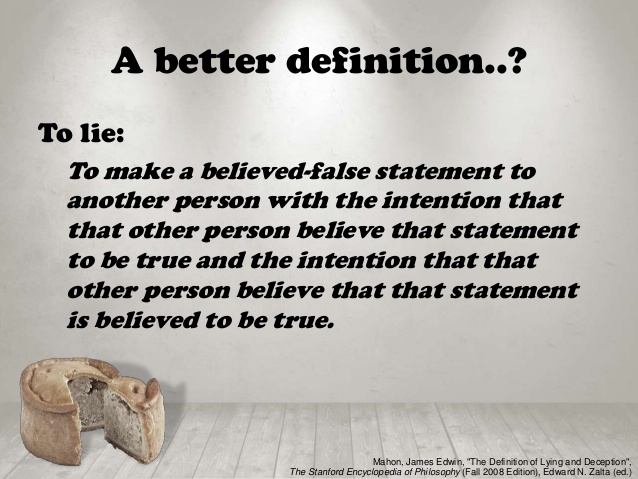
Rather than being the opposite of truth, a lie has the added qualification of intent, that is an intentionally false statement or communication.
Lies are founded on deceptions or false understandings, but if you do not know it is a lie, than it is not.  The logic here is based on the principle that without knowledge there cannot be intent.
Conceptual Analysis
It is likely most believe truth is good and should be valued while lies are bad and to be avoided.  Given neither truth nor lies have an absolute determination, the assessment of value (good or bad) has a subjective component.
Additionally a falsehood might not be truly false if the propnent of the thought or idea believes it to be true.  In this case those that view it as a lie could be doing a disservice to the believer.
Truth and lies are actually complex concepts and  how we interpret them and what they mean to us are points of consideration that deserve great caution before letting our assements of statements we believe to be lies (or true) colour our behaviour in ways we may later regret.

Teamwork

When a group of people, who know each other and are  typically aligned by organization, (e.g., family, non profit, corporate, government, sports, etc.) combine their efforts to a common action, teamwork can occur, but it might not.
It is both logical and expected that the resulting effort from teamwork will be more  effective and efficient.  That is the outcomes are easier to attain and higher quality, particularly when gauged against individual effort.
It is important to note superior outcomes are not always the case when groups work together and  can easily produce lesser results.  The term teamwork implies joint efforts are coordinated and collaborative.
The most important aspect of teamwork is to clearly understand being on a team and working together is not by default teamwork.  Without a high degree of coordination and collaboration (i.e., intuitive agreement) teamwork does not occur.
High Performing Teams
A high performing team is a group of people who share common goals, but most importantly are able to collaborate, challenge and hold each other accountable to achieve outstanding results.
Individual needs are not relevant, the group members share a clear shared vision of where they are headed and what they want to accomplish, as a group.
Building the Team
Starting with basic teamwork and then building to high performance is the best approach.  It will not happen magically and the leader will need to plan and facilitate the development of the needed collaborative attributes.
While this is not an easy task, requiring extensive planning and execution effort, the rewards are well worth it.  It is critical to recognize the need to engineer teamwork rather than magically expecting it to appear.

Inspiration

Inspiration is most commonly associated with the process of developing creative ideas.  The outcome can be behavioral or physical.

For example, I was inspired to run faster (behavioral) or I was inspired to build a better mousetrap (physical) Mostly the act of inspiration is considered positive, although that might not always be true of the results.

That is to say, by definition the ideas and plans arising from inspiration are exciting and something worth attempting.  Unfortunately the result might not inspire.

Where does it come from?

Does inspiration arise from logical planning and concentrated deep thoughts?  It can, but it also can just arise from out of the blue.  There is no formula to creating inspiration.

Of course deep thought can act as fertilizer for your brain and the growth that arises from the fertile soil (your active brain) could be inspiring.  Or it might not be.

Troubled thoughts, worry, frustration or concern can often overshadow your thinking process and dampen the opportunity for inspiration.

Inspiring thoughts can be helpful to resolve issues or conflicts and they are to be encouraged so whenever possible avoid stressful situations that with restrict the opportunity to come up with solutions that inspire not only yourself but others as well.

Seeking Inspiration

A word of warning, particularly for those seeking creative inspiration (e.g., poets, artists, authors, even bloggers) attempting to proactively seek inspiring ideas can backfire and dry up the well for a while.

Don’t push for it, just let it come.

Trade War

Canada has announced retalliation against the steel and aluminum tarrifs the U.S. has decided to enforce against Canada.  Laughably the U.S. rational for the tariffs is national security.

I refer to this as  laughable simply because the tight political and geographic alignment between Canada and the United States makes the consideration we pose a security threat simply ridiculous.

Nobody Wins

Free trade should be a prized practice and lack thereof disdained.  For me this is very much like the basic philosophical misalignment between communist economies and capitalist.

Human motivation is a very real factor in these two models.  At a very high level, conceptually, the reward incentive is reduced in a communist economy because everyone shares.

When effort is not tied to gain there is less incentive to work hard and therefore output suffers.  In the capitalist model effort is linked to results.  If you work harder, your gain is greater.

Free trade works like capitalism, what you put into it affects what you get out, without having to worry about artificial constraints.  If the government is influencing your ability to profit, through trade restrictions, this may have a short term positive effect but in the long term,  like most purely communist economies, all will crumble.

Why Fight

Ultimately everyone looses in a war, whether physical or a trade war of wits.  War is bad for the human condition and those who believe it is a way to achieve what is right are in fact very wrong.

Free trade or restricted trade, it is what it is (albeit free trade is obviously better).  However war is very bad no matter how you look at it.