Tag Archives: bias

Keeper of the Rules

Civilized society is rule based.  These range from the undocumented rules which can be religious in nature or just based on logic and common sense ( e.g. etiquette) to those are clearly documented (often called laws)

Undocumented rules are typically maintained through social pressure while documented laws are maintained both through preventive and detective methods by designated guardians with unique powers of enforcement.

Law Enforcement

Those that enforce our rules come in a variety of roles and levels of empowerment from private security to local and national police.  Depending on the role they may be subservient to governments, corporations or just private individuals.

The power granted these guardians or referees of our rules can lead to corruption and so we also have specific enforcers to monitor, detect and prevent or end corruption by our law enforcement officers when it occurs.

Working Together

Unfortunately the multi-tiered enforcement structure leads to turf wars and other inefficiencies.  Basic human nature can cause our law enforcers at different levels to battle each other just to exercise their authority and prove they are right.

Sadly maintaining perspective when regularly exposed to deceit and malfeasance requires incredible strength of will and our guardians or referees who we respect and grant license to keep the rules are not always able to maintain an unbiased view.

Flawed but Works

With the the many process flaws built into our rule enforcement it never ceases to amaze me the respect and authority we grant   our designated enforcers and their leaders nor the fact so few cases of self enforcement by individuals occur.

I guess flawed as it may be the current enforcement systems work well enough, although  there are times those when I been personally exposed to the inadequacy of the systems that I wonder if there is a better way, we just have not found it yet.

People’s Inhumanity to People

Throughout my life I have always been puzzled by man’s inhumanity to man (Retitled people above for accuracy, but I grew up in a world where strangely people were referred to as man – but that is a rant for another time.)

When I see the atrocious behavior aimed at others with full disregard for common and reasonably expected decency I wonder “People am I going insane” (also the title of a Black Sabbath song.)

Black lives matter

I can only lament how low humankind has sunk when we feel the need to highlight a group based on their appearance alone.  It is surely misunderstood for me to broaden the statement in today’s environment but for me, the correct slogan is “All lives matter”.

As I have included in many posts, the single universal core value we all need to believe and practice is the simple statement,  “Everyone is important” (even you, just kidding).

Real Change

This is again a time when around the globe people are gathering to further advance the principle that everyone matters and everyone is important.

The outrage being expressed at the incredibly biased and racist treatment observed in every country and every corner of the globe is exposed like never before with the huge assist of social media.

Just one such incident is too many, we unfortunately are suffering a plethora of such occurrences.    The history of humans is long and checkered with many attempts to create true equality.

We should never stop.  Each time the efforts of the many do change the strange and unwelcome perspectives of the few.  We need to keep at it until really everyone believes and expresses that believe through behaviour that we all deserve the opportunity to thrive.


Reductive Reasoning

Taking a subject or problem and reducing it to its simplest form can be used to help clarify but often this approach is used to refute others arguments through simplification.

The danger with reductive reasoning is it can lead to misinformation and result in the acceptance of illogical or false positions.  It can be a powerful tool of influence but caution is needed to prevent misuse.

For Example

Taking facts out of context some people are saying “Covid originated in China, clearly this means Chinese people collectively are at fault and evil.”

When the facts are reduced to their simplest perspective, often driven by personal bias we can reach weak inaccurate conclusion.  The reduced statement of fact is often little more than wild pontification.

Coupled with binary thinking this approach can breed prejudice.  That is there are only two options, for example  the Chinese attacked the world with covid or they did not.

Things just are not that simple in reality.

Victims of Bias

I am a white person married to an asian person. This offers me an interesting perspective on racism.  I have watched my wife experience racial bias (e.g., airport security) and it always saddens me for all of humanity.

Why can’t we all just be friends?   I wish this were a rhetorical question, unfortunately it is not, I don’t know the answer.  The motivation for racism escapes me.

Fortunately my own natural environment has enabled me to view everyone as people.  Admittedly I like some people and dislike others but the decision is always based on their behaviour never appearance.

Telling the Story

Often it is not the facts that dictate what others perceive, when you are relaying information to them.  Most significant is how you tell the story.

The way you filter the facts reflects your own views and is instrumental in dictating the way you will craft the story.  It is not so much about the facts as it is the message you want others to take away.

For Example

A colleague was recently sharing with me some stories he had heard about recent events in Hong Kong.  These were both first hand from friends and relatives living in Hong Kong and news feeds he had read.

The stories began from the protestors perspective and clearly portrayed  the police as being the instigators and at fault.

Typically in these types of conflicts the facts can provide justification for all parties actions.  The stories sounded rather one sided so I asked if he could relate some of the incidents from the police perspective.

My thought was this would result in a more balanced view overall.  I quickly realized how you tell the story often includes your personal bias.

Unsurprisingly I suppose, even when told from the polices perspective the villains of the tale were still the police.

Developing Conclusions

Regardless of how gripping or well told the story is probing questions based on an unbiased and balanced view can help you be more likely to come to a fair conclusion.

Remember we all relate facts as simple and straightforward without even realizing that they are coloured by our bias.  Often you need to do some work as the listener in order to get the accurate story.


The Man Cold

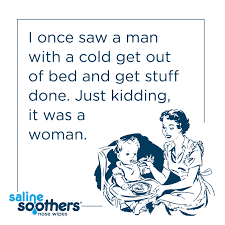
I recently contracted a cold.  It began with an irritated throat, migrated to a stuffy nose and sinuses ultimately leading to overall fatigue, aches and pains.

I never complain about such minor illness, but I did mention it to my wife who passed on the information to my daughter.  “Oh he has a man cold eh!” she said.

The Man Cold

Not being current on all the latest jargon I decided to investigate the meaning behind the phrase.   It is  defined as an affliction usually caught by boyfriends or husbands, exhibiting cold-like symptoms, but no one has ever been as sick or tired as one who catches the man cold.

Really, I was beginning to sense I was the victim of an unconcious bias propagated by the female species.  This was how strong, self motivated and independent males were being viewed.

Digging Deeper

I continued my search and the level of sarcasm increased.

“The name ‘man cold’ disguises the true terrible, debilitating disease that is the man cold. Nearly all men will die from man colds unless they are administered immediately with large amounts of mindless TV such as Big Bang Theory or childrens’ songs (the wiggles anyone). It is essential that they not move from bed or a comfy sofa to allow for rehabilitation and must have tissues and man cold medicine (such as chocolate biscuits, McDonalds, or a nice cup of tea) brought to them constantly by a nearby female.”

Sadly for me I had to suffer in silence and care for myself.  No sympathy.   Of course I had the deadly man cold but it’s a good thing I am a manly man and can take care of myself.

Conscious Thought

Conscious thought requires more effort than unconcious thought.  It is theorized that one possible cause of autism is a persons inability to think unconciously.

While most people can behave in an autonomic  way for many routine actions it’s thought those inflicted with autism have to think through eveything in a conscious way.

The danger of Unconcious thought

In theory, being able to rely on predefined soltions to external behavioural clues allows us to focus on the important things directly and conciously.

Those things that require analysis and thought to arrive at informed conclusions, and subsequently, leading to  appropriate behaviour are best handled consciously.

Think about the scenario first thing in the morning.  You begin to encounter other people and mainly great them with a “good morning”.

This is a typical sub conscious behaviour.  Somewhere in your store of unconscious behaviours is a routine grreeting to use in the morning even when it is not reflective of reality.

How often have you muttered good morning to others when in reality for you it was anything but.  People with autism will usually think consciously what their morning  greeting should be and then say it.  Many of us find this disconcerting.

And so that highlights both the benefit and danger of unconscious autonomic behaviours.  They may not really be appropriate because they are based on a pre-defined action and so they could be off putting to some or result in truly inappropriate behaviour.

Of course acting conciously when a routine action is expected could be unnerving as well.  On the whole though acting consciously is more likely to be both supportable (you had a well thought out reason) and the outcomes will often be better.

The past is better

We humans have a very interesting ability to transform reality to fit our conclusions.  This is a form of bias and a well studied and documented behaviour.

I’ve Never Seen it this Bad

An interesting variation on this  natural occurence of bias is the way we can reimagine the past as being far better than the future.  I wonder about comments like “ I ‘ve never experienced service this bad”

Or, “The leadership here is very confusing relative to my previous experiences”.  These statements are subjective in nature but also in and of themselves, self justifying interpretations of the current experience.

In reality, most people experience good and bad behaviours (e.g., service, leadership, relationships) throughout their lives.  Comparison with the past is a great rationalization technique, but is it accurate?

Danger!

A word of caution about justifying conclusions without independent confirmation.  Your interrpretations of inadequacies within your current circumstances might not be as bad as you think, or maybe even not what you think at all.

Your conclusions will influence your own behaviour, but like all actions derived from some form of bias the results could backfire on you.

The past is not necessarily as you remember it.  Years of maturing can mould memories.  Coupled with the conclusion bias ( i.e., what you want it to be, but maybe not what actually is) there is a risk these memories will influence you to act in ways you might regret.

Often discussion with others is all that is needed to help reshape the past to more closely resemble events as they happened.

Leveraging Bias

Everyone with a brain has some bias.  This can be unconscious (automatic or implicit) as discussed in yesterdays post.  Or you can be fully aware and elect to believe and act accordingly (or not).

For me having a bias is neither good nor bad, rather it is how you deal with it that is important.  For many bias is often thought of in negative terms.

If your behaviour resulting from personal bias is effective, because you make it so through thoughtful consideration, I see no fault.

Acting automatically on a unconscious bias  without analysis of the consequences, or a regard to results is when problems arise.  This usually creates negative consequences.

The consequences might be immediate or long term, impacting your relationships but probably, sticking to a bias when evidence strongly suggests otherwise does not lead to positive outcomes.

Self Awareness

Behaving with a high degree of self awareness is a good way to mitigate the risks created by. your potentially harmful bias.  You might not change or drop your bias, understanding it and behaving accordingly is all that’s needed.

For Example

You may have a bias to alternate sexual orientation.  Yet interacting respectively with all others (everyone is important) regardless of your bias, should be your chosen behaviour.

When your bias is conscious you can choose how to act.