Tag Archives: past

Leveraging the Past and Future

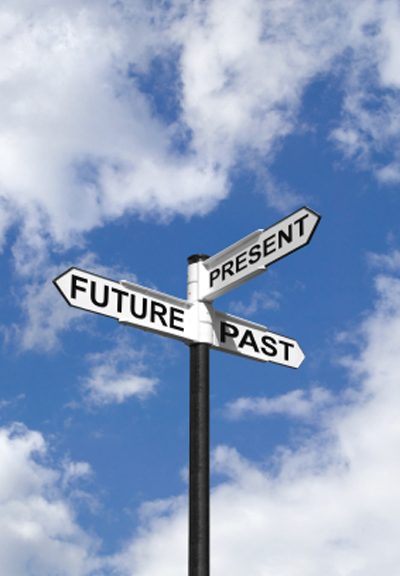
Ground your present through reference to the experiences of the past and the prophecies for the future.  These things can be key to helping us be successful in the present.

Things that occur in the past or we perceive as future opportunities are not a solute predictors of the present but deserve our consideration as potential influencers.

Past Outcomes equal Present Facts

The past represents facts, that is they are things that are known and can be demonstrated  as being true.  The past occurred and the outcomes are a real although interpreting what they mean can be somewhat subjective.

Predicting future events with accuracy depends depends on how much is known about the options and their potential likelihood.

Using future predictions together with analysis of past outcomes needs to be done with careful and considered analysis.  Other factors must be taken into account as well.

What has happened or prognosis for what will happen are important, even critical decision making parameters relative to ensuring the best decision but they should not be used at the expense of all else (e.g., intuition).

Repeating the Past, Ignoring the Future

Consideration of what has transpired in the past before acting in the present is obviously an important factor in avoiding the repeat of sub-optimal outcomes.

Likewise using likelihood estimations of future projections avoids performing actions in the present which will not conform with what the future will be.

Simply paying attention to what has and will happen in order to make good decisions seems like basic common sense yet surprisingly these things are often ignored.

Seeing the Future

The past is indicative of the future.  Looking backwards can guide you forward.

Most investment information, things like analyst reports, prospectus, financial projections often carry warnings about forward looking statements.

The purpose of this caution is really to mitigate litigation.  You told me this investment would have a 19% return.  The future predictions I speak of are not quesses with a bias, but rather informed based on events.

Behaviour Focused Interviewing

More and more hiring managers are using behaviour focused interviewing and associated research into a candidates past accomplishments.

The results of a number of studies show a direct correlation  between  behaviour focused interviewing and new employee retention  and performance results.

This technique is simply leveraging the concept that the past can be used to predict the future.  For example if a person has a track record of success under stress if you hire them into a role with a lot of stress it is not a stretch to expect them to be successful.

Not Infallible nor Absolute

The idea that the past equals the future can be a very dangerous postion to about.  Indicative simply means a specific result might be more likely and is worth considering.  It does not mean the future result will be a certainty.

Past performance, be it an employee, stock price dividend or even a winning race horse can definitely lower the risk of you making a failed choice as is frequently noted with  forward looking investment advice, do not throw caution to the wind.


The past is better

We humans have a very interesting ability to transform reality to fit our conclusions.  This is a form of bias and a well studied and documented behaviour.

I’ve Never Seen it this Bad

An interesting variation on this  natural occurence of bias is the way we can reimagine the past as being far better than the future.  I wonder about comments like “ I ‘ve never experienced service this bad”

Or, “The leadership here is very confusing relative to my previous experiences”.  These statements are subjective in nature but also in and of themselves, self justifying interpretations of the current experience.

In reality, most people experience good and bad behaviours (e.g., service, leadership, relationships) throughout their lives.  Comparison with the past is a great rationalization technique, but is it accurate?

Danger!

A word of caution about justifying conclusions without independent confirmation.  Your interrpretations of inadequacies within your current circumstances might not be as bad as you think, or maybe even not what you think at all.

Your conclusions will influence your own behaviour, but like all actions derived from some form of bias the results could backfire on you.

The past is not necessarily as you remember it.  Years of maturing can mould memories.  Coupled with the conclusion bias ( i.e., what you want it to be, but maybe not what actually is) there is a risk these memories will influence you to act in ways you might regret.

Often discussion with others is all that is needed to help reshape the past to more closely resemble events as they happened.

Living in the Past

I read a quote from former US president Bill Clinton today.  “When our memories outweigh our dreams, we have grown old.”  The quotes juxtaposition between memories and dreams intrigued me.

You could intrepret this statement to imply dreams are to live for while memories are the past.  These reminisces  can provide pleasure, but also pain, they don’t lead to action, it is already done.

Weighting Dreams and Actions

On the whole, I very much enjoy remembering my past.  My life has been a happy one and so far my personal goal of attaining maximum happiness and pleasure has been achieved.

Interestingly this was accomplished not by dreaming, but rather by taking action. Of course,  dreams can lead to action, and I am pretty sure that was the underlying assumption Mr. Clinton had when he made the quote.

Without some attempt at realization, dreams are just empty thoughts.  Memories may not move you forward but they derive from dreams that were realized.

Doing Less

If memories require dreams to be acted on, than more dreams than memories implies less action, which is often considered to be an attribute of getting old.

Although, as the population ages this becomes less and less true.  The number of instances of active oldsters (e.g., people over 100 running marathons, doing acrobatics or acting in major films) continues to be on the rise.

These active oldsters have both ample memories and dreams they are aggressively persuing.  This current reality  makes Mr. Clintons quote somewhat an anacronism of the past.

I dream about my future successes and accomplishments and I am actively planning how to achieve them, even after I reach 100 years old.