Tag Archives: personal values

Behaviour Values

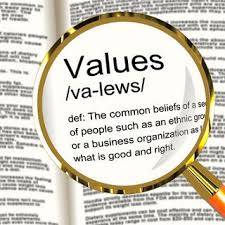
Your personal values are the things that you believe are important in the way you live and work.  For the greatest level of internal serenity the  way you behave should be in accord with your values.

When others believe your behaviour is wrong and ask you to change,  assuming your behaviours are consistent with your values (i.e., your integrity is intact) there is a problem.

Behavioural Issues

I heard an interesting story the other day about a frustrated mother attempting to stop her nine year old daughter from lying.  After one confrontation the daughter demonstrated an amazing level of maturity.

“Mom”, she said “ The issue is not my telling lies, rather its the fact you don’t want me to”.  Out of the mouths of babes.  What the young girl was questioning was why she needed to adopt her mothers value.

Tell the Truth

Truth telling is generally accepted as an intuitive value that should be commonly held.  Yet frequently people lie to avoid embarrassment or confrontation.  This is generally considered acceptable.

For example, I can’t make the party because I have an appointment might be an excuse you use to avoid attending a party even when there is no appointment.

Who is Right

Behavioural expectations can often be subjective and mostly based on the expectors value system.  This can cause conflict and stress people by expecting them to shift their value system and conform.

Often majority rules is used as a justification for this.  Polite society must have some boundaries.

There is no definitive answer to the issue of different perception of values and their associated behaviours but it helps to recognize this ambiguity does exist and needs to be dealt with.

Being Valued

Whether you are managing, leading or just in an authority roles (parent, policeman, teacher) one of the most important behaviours you should practice, is respect of others.

Listening attentively and acting, even if not fully in your own interest is key to making others feel valued.  As athletes well know believing you are a winner is required if you are going to be a winner.

Similarly feeling, valued, respected, important are really strong motivators.  Recognition feeds a persons need for self actualization.  In Maslow’s heirarchy of needs this is at the top of the pyramid.

How is this achieved

Feeling valued is as much an intuitive feeling as it is an logic driven internal assessment.  That is you can consciously analyze the way people are behaving and interpret it as respect or you can just feel it unconciously.

For leaders, managers and other authority figures it is important not just to address the conscious interpretations of your actions, but also the hidden messages you send, for example body language, demenor or broadcasting your negative feelings.

Feeling Discounted

When you are interracting with someone who is making mistakes or behaving badly or acting stupidly (in your assessment) it is easy to discount their behaviour.

Being derisive or abrasive, for example when someone is talking too much (and you are busy) is relatively easily done.  This could solve your immediate needs.

However,  the recipient is unlikely to feel valued.  Ultimately  this results in a disaffected and demotivated person.  Something that, as a leader you want to avoid.

Using Values to guide your behaviour

I had an interesting discussion today about the value of personal values.

Personal values are your internal conception of what is good, beneficial, important, useful, beautiful, desirable, constructive, etc. In essence the values are used by you to guide your behavior.

Behaving Consistently

In any given moment how you react/ behave depends on a myriad of factors both external and internal to yourself.  A strong personal value system simply provides a support guideline to help ensure the internal factors coincide with your conception of what is good.

It is actually quite easy for the external influences to override your logic and cause you to behave in a way you don’t really want to and under less stressful circumstances, would not.

Although it is certainly not a fool proof method, by adopting a simple set of values, which are easy to remember and understand you will have a fall back to assist in behaving the way you want to.

An Example

“If I say I will, then I will”   This value statement falls within the category of Integrity.  It is simple, easy to understand and follow.

Let’s say you told a friend you would meet them at 2:00 pm on a Saturday at a coffee shop downtown.  Between the time you made the commitment and the time of the appointment your circumstances changed and you no longer want to meet.

Your personal value dictates you will arrive at the appointment (unless alternate arrangements are mutually agreed).  To the person with this value, a promise is a promise.

Keep it simple

With a small and clearly defined set of values (I have four) you can help guide a significant amount of your behavior.

Back to the discussion that prompted this post, my view was the person with the internal guidance support provided by simple, easily followed values will most often be perceived to have the best behavior.   That is on an overall macro basis.

This does not mean they would never have bad behavior, just the chance their behavior will generally meet their conception of good will occur more often.

On the whole this will improve their interaction with others and visa verse


Ideas, Innovation and Entrepreneurs

What are the qualities of a good entrepreneur?   Is it the entrepreneur or the idea that leads to success?

Just to be sure we are thinking of the same definition, here’s a standard one  from dictionary.com:

“A person who organizes and manages any enterprise, especially a business, usually with considerable initiative and risk”

There are many well known and broadly communicated success stories of people who started a business with minimal resources and became huge successes. ( Apple, Microsoft, Blackberry, etc.)

What is not as widely publicized are the  details of the failures – that is to say what was tried and how it failed.  Of course from a big picture perspective  the failure rate for entrepreneurial start-ups is pegged around 90% ish (depending on whose study you read)  so the likelihood of succeeding is known to be low and readily available in public media.  However, the stories of what did people try and why did it not work are usually not the topic of books, articles, talk shows, etc.  (I guess general in our culture failure is not celebrated).

Stories about lack of success are the opposite of the success stories, however, both examples can help understand what kind of skills, values and approaches form the underpinning of successfully building a business.  It would also help put some perspective on how much of success was attributed to good ideas and how much to the entrepreneur themselves.

The athlete model

While I don’t have a bunch of data or reference points proving my own view, I still believe the majority of the success lies with the entrepreneur themselves.

Consider successful athletes at the top of their sports.   Those in the top ten are probably equally skilled and capable but the athlete that rises to the very top succeeds through motivation and drive.  They vision the win and then they win.  Of course this is not an absolute philosophy but I wager that on the whole it the most critical success factor – believe in yourself, don’t doubt, don’t question – just proceed.

My favorite summary of this attitude is the simple quote from the Yoda character in the Star Wars film series – “There is no try, just do or do not. ”

Is there a point to this post?

Today’s message is short, brief and pointed – trust in yourself, if you think you can, then you can!