Tag Archives: criminal behaviour

Impeachment

Hot topic in the news these days is the impeachment of Donald Trump.  People think impeachment means he will be removed from office.

This is not necessarily the case.  It can be a step in that direction but the process mirrors the U.S. federal justice system.  In criminal proceeding (not related to political office) a grand jury is struck to determine if there is enough evidence of a crime.

Grand Jury Outcomes

The prosecutor puts his case to the grand jury, there may be witnesses but there is no defence.  If the jury believes the person being investigated might be guilty an indictment is issued and a criminal trial ensues.  If not, the matter is dropped

In the case of elected officials (at the federal level) instead of a grand jury investigation, a house of representatives investigation is conducted.

Instead of issuing an indictment when the politician is considered guilty an impeachment vote  ensues and if passed the result is virtually the same as an indictment, a criminal trial must be held.

In this case though the trial is held in the senate.

Presumed Innocent

Just as in a trial arising from an indictment the accused in an impeachment is presumed to be not guilty.  The trial must prove guilt beyond a shadow of a doubt or there are no consequences (beyond public opinion, a reputation can be tarnished).

So if Trump is impeached he will go to trial in the republican controlled Senate.  It is doubtful they will find him guilty of the crime of which he has been accused.

Impeachment will hurt his reputation but will not force him from office or even from being re-elected.

High crimes and misdemeanors

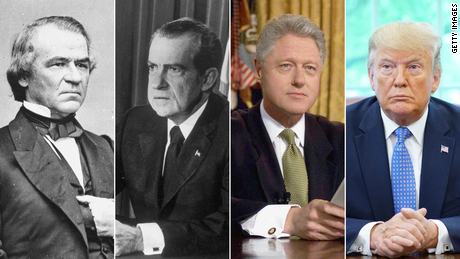
Only two U.S. presidents have been empeached and a third resigned before empeachment.  Neither of the empeached presidents were convicted of the crimes they were accused of.

Impeachment does not necessarily result in removal from office; it is only a legal statement of charges, parallel to an indictment in criminal law.

Both of the empeached presidents, Andrew Johnson and Bill Clinton were acquitted by the senate and so stayed in office to end of their terms.

Nixon

Richard Nixon is the most interesting case.  He decided to resign before the impeachment hearing, thus avoiding both empeachment and being turfed from office.

Following his resignation, Vice-president Johnson (Nixon’s running mate and friend) pardoned him.  This avoided a trial where he was actually convicted and sentenced.

The acceptance of the pardon is said to represent an admission of guilt on Nixon’s part, but that is just supposition.  If he had declined the pardon and gone to criminal trial many would have been more satisfied.

Trump

Recent events involving former FBI director Comey and Trump have raised the possibility of obstruction of justice, which is a crime.  High crimes and misdemeanors can be a cause for empeachment.

If empeached though, the senate would still need to vote Trump out of office by two thirds majority which based on past history, is unpresidented ( no pun intended).

Whether there are tapes or not of Trumps alleged obstruction, it is highly unlikely he would resign like Richard Nixon.   So to all you hopeful optimists out there, I don’t think its going to happen.