Tag Archives: jargon

Sounds Deep

I read a Dilbert comic (by Scott Adams) the other day where the pointy-haired boss announced to the team “Let’s do a deep dive in the big data and drill down until we hyper localize some disruptive technologies.”

Putting the comics ultimate punch line aside, just focusing on the leaders rhetoric, which was meant to be a serious direction to the team, I was saddened by the accuracy of the statement in the context of a regular working meeting.

This type of jargon without real meaning is used in our society far too often.  Sounding intelligent and knowledgable is considered a valued skill.

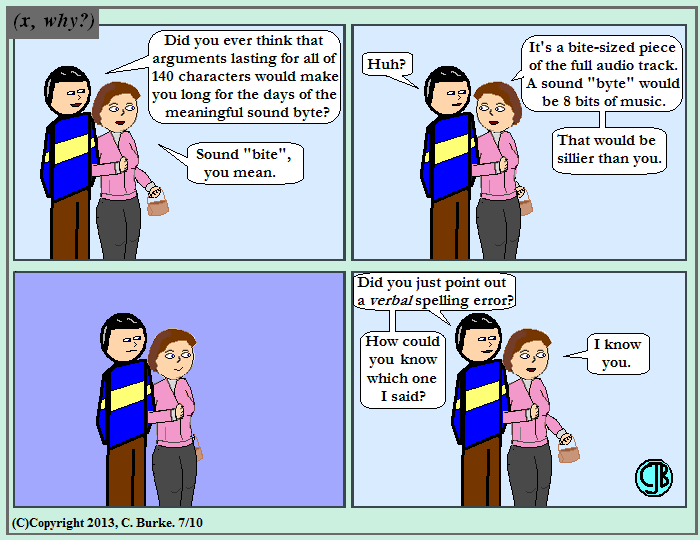
The Sound Bite

Fast easy to access communication is is a bi-product of the internet and associated technologies (e.g., mobile devices).  More than ever before in human history we are able to access and consume information from all corners of the globe in seconds.

With the dawn of live radio and TV, (i.e., the initial forrays into efficient wide access communication technologies) one way this ability to provide an immediate message was heavily leveraged is the sound bite.

Technically a short extract from a recorded interview, chosen for its pungency or appropriateness I use the term here more broadly to refer to a short, catchy snippet of speech.

The drawback is these snippets often, like the Dilbert example,  sound great but are largely meaningless.  The real consequence is people interpret and act on what they perceive the meaning to be.

Sadly, mostly they really are intended to do is improve the pronouncers reputation.   Shallow leaders make themselves appear deep.  Misinterpretation can lead to dangerous results.

Acronyms and Jargon

I am currently reading “The Prisoner of Guantanamo” .  while it is a fictional account, the author was a reporter turned novelist and I have found his previous books to be quite accurate.

At the beginning of the tale there is a three page section dedicated to the jargon and acronyms of the Guantanamo Bay naval base and prison.

One Language is not enough

I started to wonder about the adequacy of the English language.  Clearly it either not descriptive enough , too complex or hard to pronounce.

The solution appears to be just to create language addendums (jargon) and shorten phrases and things to the first letter only (nouns).

All of this creates an advantage for those who know the terminology.    They understand the conversation while another might not until familiarity sets in.  Until all are fluent those in the know have some power over the others.

Is there a value to “org” speak.

Having organizational or even family specific jargon can speed information exchanges but often at the risk of decreased clarity.  Jargon is often vague (intentionally so).  It sounds cool but often actually means little.

For example, I love the phrase “I’m on it”.  Often used to convey the message that the task is underway.   What task, what objective and when will it be done are not part of this message, but it sounds good.

Crisp, clean seems to have meaning.

Plain English

While jargon and acronyms are used extensively, I alway question the purpose.  Is this for communication or power? (I understand stuff you don’t).

For me, sticking to plain English is the method of choice.